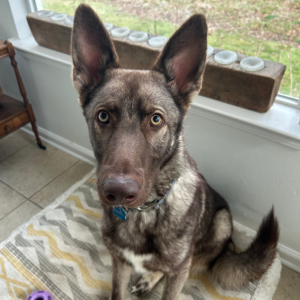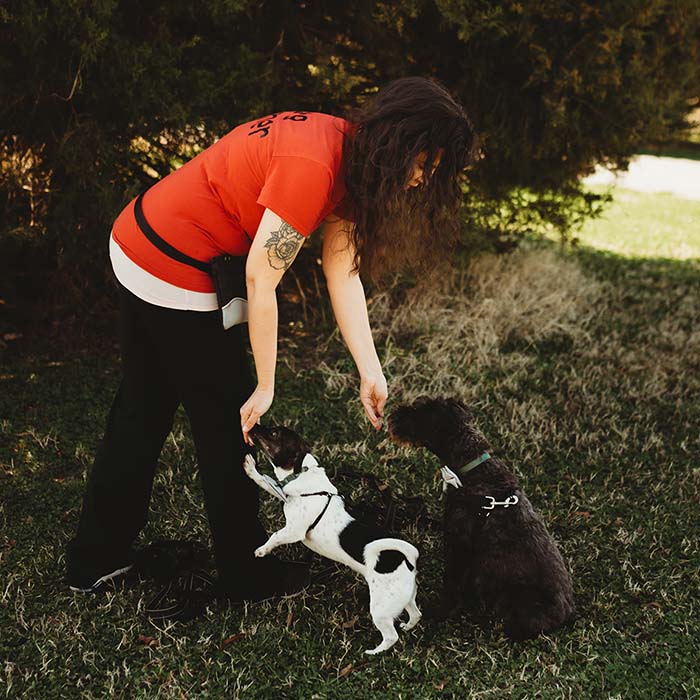
Indie appeared to be a young, healthy English Setter.
He was friendly and cuddly, often seeking pets from his male owner. He played fetch hard and loved going on walks.
I got the call, however, after a bite. He randomly went after his female owner, and seemed to have issues with their daughter as well. The family was confused. Most of the time, he seemed happy and friendly and content. He was doing everything a dog was expected to do for the majority of his day.
I sat in their living room with them, observing Indie. I didn’t see anything in my entrance that caused alarm. I have a few set ups for dog aggression, depending on the situation. For some dogs, we even start with virtual sessions instead to work on training on how to manage and direct. I walk everyone through proper introductions for more nervous or anxious dogs.
Indie needed none of those things.
He rested at my feet, mostly ignoring me and certainly not showing any of the typical signs that a dog was uncomfortable.
Those signs can include:
- Tense body language (unable to loosen muscles at all)
- Whale eye (staring out of the corner of their eye)
- Hard stare (staring directly)
- Moving away
- Hunched body language (folded in, stiff stand)
Until I shifted my foot, and slightly, ever-so-slightly, grazed his rear fur (not even his rear itself, just a little bit of his fur) with my foot. He spun around abruptly and looked at me before settling down again.
I suggested that he get a pain work up.
These days, especially with eight years behind me as a dog trainer, I suggest pain checks more than not. Let’s just make sure there’s no old fractures, arthritis, or hidden bullets. Sometimes, a vet doesn’t find anything, sometimes they find something but don’t think it causes the dog pain, and sometimes they find a clear cause, or multiple causes, for pain.
Rebecca Barr, BVMS MRCVS MSc, writes in the IAABC Journal that “Osteoarthritis (OA) is a disease commonly seen in pet dogs. It has been found that 80% of dogs over the age of 8, and 20% of dogs over the age of 1 have osteoarthritis to some degree, with complications of arthritis being one of the leading causes of euthanasia in older pets.”
UPenn School Vet Medicine published a 2024 study that reported arthritis, skin/ allergies and gastrointestinal upset can all have a significant impact on increasing: stranger and owner-directed aggression, touch sensitivity, separation anxiety and excitability*. (VBS 2024; Mitchum, et al, UPenn School Vet Med.)
Track behavioral changs, especially sudden ones:
– Is the dog suddenly peeing more frequently, particularly in the house?
– Is the dog suddenly peeing on your bed or their bed?
– Is there random, seemingly unexplainable aggression?
– Are they hesitant to do something they used to do with ease, like go on walks, jump on the bed/couch, or go up and down stairs?
However, we also have to take the time to make sure we understand the dog’s normal. What does their typical behavior look like, and have we ever seen it?
Indie’s people took him to Dr. Karen Lechelt at House Veterinary Clinic. They reported that she spent over an hour examining him and took x-rays and told me, “We really liked her. Thank you for the on target referral!”
But the findings were grim. She found sensitivity around back and hips, muscle atrophy, one rear leg was shorter than the other, and his gait was choppy. The X-rays showed:
- Severe hip dysplasia on both sides (no ball & socket at hip joint)
- Intervertebral disk deterioration
- Bone spurs
- He had been shot several times (bird shot & BBs)
- He was likely middle-aged at about 6 or 7, not 2, like originally believed
It was also possible he had some nerve damage, maybe from being hit by a car, or maybe from genetics. They decided to move forward with a surgery to improve his quality of life, and understood his behaviors much better, including how to manage them.
Indie certainly isn’t an outlier in my clients, or even in my own house.
Charlie, a five-year-old Pomeranian, was suddenly peeing in the house. He had a fractured jaw. Jeeves, my own 13-year-old miniature Schanuzer, was suddenly refusing to go on walks. He wouldn’t climb the stairs and stopped jumping on the bed. I attributed his odd behaviors to getting older, until I saw his leg spasm and I called our vet, Dr Marlow Ball at SoMa Animal Clinic. She found a spinal injury.
It’s always a good idea to check your dog regularly. Check their teeth, skin, and paws. Learn how to listen to their heartbeat and what the normal resting rate is. A couple of years ago, I decided to brush my dog Lexi’s teeth after neglecting the practice for a few weeks, and I found a tooth sticking out to the side. I was horrified. How long had she been in pain? How much pain was she in? She had given me no signs at all. I brought her in to see my vet, who was able to pull out half of the tooth, but the root migrated out of reach into her nasal cavity. She ended up needing to go see a specialist in northwest Arkansas, where they put her under and discovered that the piece my regular vet hadn’t been able to extract had been either swallowed or sneezed out.
Despite commonly held beliefs about dogs, they don’t tell us about pain. They often don’t yelp or limp or refuse. They can, like Indie, chase a ball to a dangerous degree, or even climb Pinnacle despite suffering heat stress or be on the verge of heat stroke.
Pain shows up in weird ways. It’s not personal. If your dog is refusing to do something or is hesitant to do something, pay attention. They’re not trying to be dominant or “show you who is boss”. Their whispers tell us huge amounts of information, if we know what we’re looking for.
If your dog is acting in strange ways, a call to your vet is a good place to start.
—
Not sure what to look for? We can help. Email info (at) telltaildogtraining (dot) com.